Each system design should start with a water test.
We offer FREE in-house and certified laboratory testing.
We offer a wide selection of water filtration and water treatment solutions, so there is something for every household!
Check out our selection and let’s get started on providing the best quality water for your needs!
To maintain optimal drinking water quality and water safety, water filters should be changed every 6-12 months for best results. We make it easy to replace broken or outdated water filters.
Request a filter replacement by filling out the form.
Your filter will be ready for pickup. Replacement is easy to do yourself!
Water filters should be changed every 6-12 months for best results.
We understand that you may think water filtration is a pure luxury and not a necessity. Here are some facts that might change your mind and make you rethink the importance of clean and drinkable water:

According to the Centers for the Disease Control and Prevention (CDC), more than 1.1 million Americans get sick every year from drinking contaminated water.

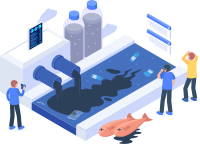
More than 60 million Americans are exposed to unsafe tap water each year. The problem is more pronounced in smaller and rural communities.
Your consumer confidence report provides some information, but to get a more detailed look at the environmental quality of your drinking water, you need a detailed test. Click the link below to access the Environmental Working Group’s (EWG) Tap Water Database to get the most recent harmful contaminants found in your local water utility’s water. This will show you which contaminants are affecting your home.
We are Intown Plumbing, a professional team of certified contractors and water specialists located in Rockwall, Texas. Our goal is to diagnose and solve water quality problems, taking your concerns into account. We customize water treatment solutions to each household’s needs. We do not use a one-size-fits-all solution, nor do we oversell.
We offer FREE Water Testing: We start with a FREE water testing and analysis to determine the specific contaminant levels in your water sample. Understanding the water quality indicators is the first step.
Customized Solutions: Your water quality is unique. Whether you have hard water, microbial issues, or concerns about industrial chemicals or lead in your groundwater, we have a range of treatment options.
USA Made Products: We stay educated and up-to-date, and ensure that all our equipment meets the highest quality industry standards. Almost all of our products are made right here in the USA.
We have more than 30 years of field and professional experience
We provide a wide range of water treatments for our customers.
Not sure where to start? Need help deciding on a water filtration system?
Take a look at some of our most useful articles. They help our customers make the right choice for their household
Five essential parameters commonly tested to assess water quality are pH, Dissolved Oxygen (DO), Turbidity, Total Dissolved Solids (TDS), and Microbial Contamination (like coliform bacteria). These tests provide a baseline for identifying chemical and biological risks.
The cost for a home water quality test varies widely based on the complexity and number of contaminants being tested. Simple in-home kits may cost under $50, while comprehensive, certified laboratory tests for heavy metals and complex chemicals can range from $100 to over $1,000.
Water quality is a quantification of the chemical, physical, and biological characteristics of a water source relative to the standards set for its intended use, such as drinking or supporting aquatic life. It is assessed by measuring contaminant levels and comparing them to regulatory limits set by organizations like the EPA.
Determining the single “highest quality” drinking water in Texas is difficult, as quality can fluctuate and is judged by compliance with various standards. Public water systems, like those serving major cities, must meet EPA standards, and you can check specific performance data on databases.
No, a standard smartphone cannot detect underground water, as it lacks the necessary magnetometers or radar for geophysical surveying. Apps claiming to detect water are generally for entertainment or to locate known public water sources on a map.